
Cannabis Laws in Europe: What's Changed in 2026
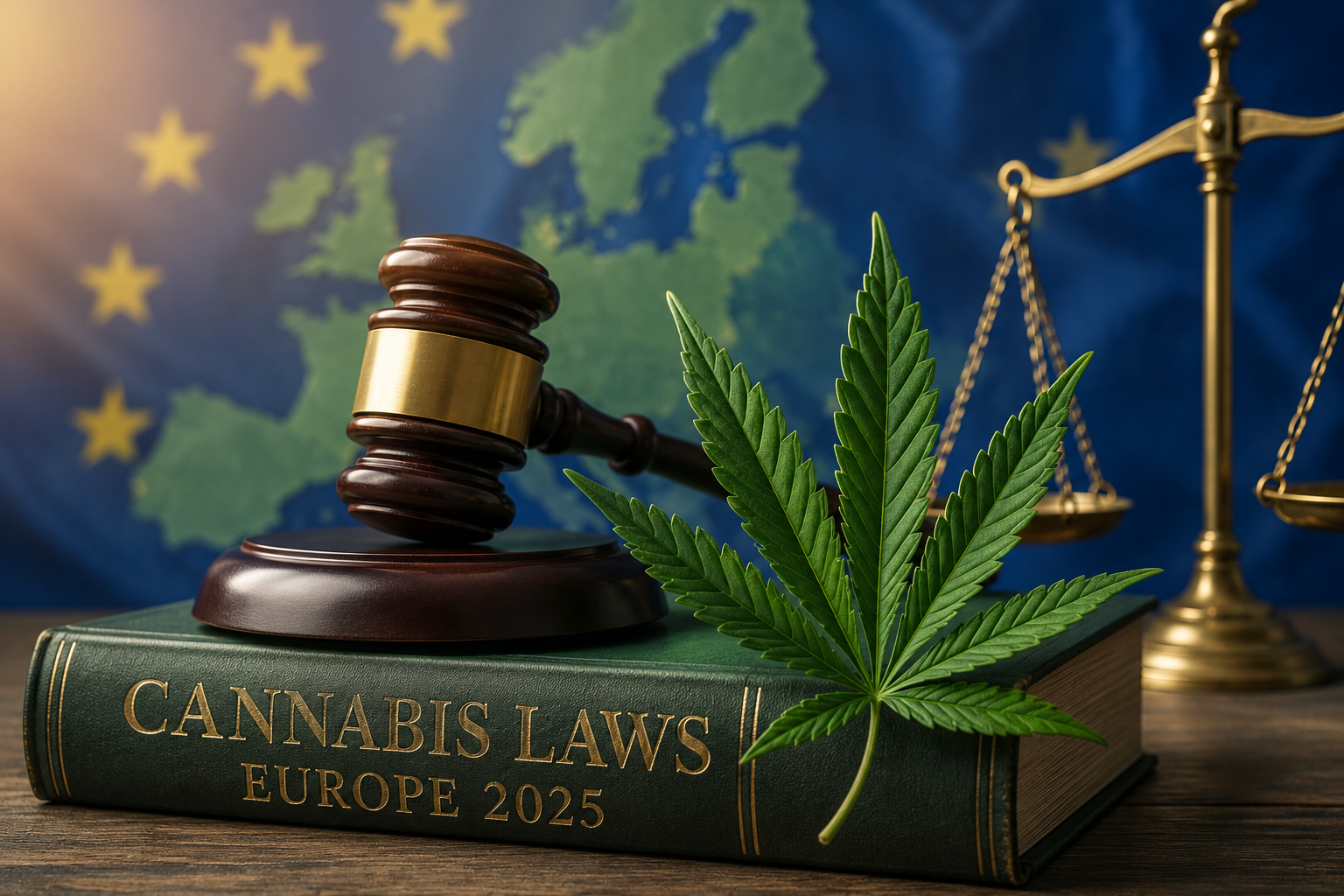
European cannabis policy has accelerated in the last two years than it did over the previous twenty years. A decade or so ago, decriminalisation and tolerance policies were everywhere but patchy. Now there are more structured approaches to legalising cannabis emerging in major economies through partial legalisation; regulatory pilots in other jurisdictions and increasingly governments are framing the issue in different ways. Therefore, 2026 is an important time for UK travellers, expats, and anyone following cannabis policy changes globally to take stock of where we have got to.
Germany: The Biggest Policy Shift in Europe
Germany’s Cannabis Law (Cannabis Gesetz), which allows adults over 18 to possess cannabis, entered into effect on April 1st, 2024. This is the first time a large European country has legalized cannabis. The law will be in full operation by 2026 and it will become apparent how the new law functions.
Legal for Adults Over 18:
- Possessing up to 25g of cannabis in public areas
• Possessing up to 50 g of cannabis in private residences
• Cultivating three female cannabis plants for personal use
• Participating in membership-based cannabis social clubs (Anbauvereine) – These can include as many as 500 people who grow and sell cannabis among themselves. They cannot sell cannabis to non-members.
Illegal for All People:
- Commercial retail sales — No licensed retailers exist in Germany. Phase two of the law regarding the regulation of commercial sales is currently being debated in Parliament.
• Consuming in an area 100 meters of schools, parks, playgrounds, sports fields, and shopping districts.
• Consuming in front of minors.
• Buying from anyone but a registered Social Club member.
For Visitors From the U.K.:
German cannabis social clubs require their members to reside in Germany. Therefore, a tourist may neither purchase nor participate in social clubs. However, tourists can possess cannabis while they are in Germany as long as they do so under the limits allowed under German law. For example if a person is visiting Germany and is found in a public place with no more than 25g of cannabis they would technically be operating within the bounds of the law.
Berlin, Hamburg, and Munich all have active cannabis communities and there is very little enforcement of individuals possessing small amounts of cannabis.
Czech Republic: Legalisation on the Horizon
For years, the Czech Republic has had one of Europe’s less strict “decriminalization” frameworks – personal possession of no more than ten grams of cannabis is an administrative (minor) offense rather than a criminal issue. However, by 2026, the cannabis policy landscape has dramatically changed.
In 2024, the Czech government introduced a framework law allowing the operation of a regulated cannabis marketplace. Licensed cannabis retailers are expected to open for business in 2025-2026. Details include:
- Cannabis can be purchased at licensed retailers by adults who are eighteen years old or older;
- Cultivation of up to two plants in a home will become legalized;
- Regulations on the quality and labeling of products are currently under development;
- Revenue generated from taxes was a major factor in the political agreement for implementing a regulated cannabis marketplace;
- Prague is already among the more visible CBD & gray markets cities in Central/Eastern Europe, and has operated as such for many years. Legalizing cannabis will place the entire industry within a regulatory structure.
For U.K. travelers: As it appears the Czech Republic may soon be one of the easiest places for U.K. tourists to access cannabis for recreational purposes due to its retail availability without requiring residency or membership in a club.
Netherlands: The Supply Chain Experiment
Beginning of Text The Dutch coffeeshop system has been the longest-running and most widely accepted regulated cannabis retail environment in Europe. It is unique in that while sales through the front door have been tolerated for decades, the supplying of coffeeshops via the back door remains illegal. In an attempt to solve this dilemma, the Dutch government launched in 2023 a new experiment called the “Gesloten Coffeeshopketen” or closed coffeeshop chain experiment which creates a completely legal cannabis supply chain for coffeeshops directly connecting licensed growers and their products to coffeeshops.
By 2026 ten of the Dutch municipalities will be testing out the coffeeshop chain experiment. Those included in the test group will include Tilburg, Nijmegen and Breda. All licensed cannabis producers will provide all participating coffeeshops with product that meets strict regulatory standards and includes standardized labeling identifying percentage of THC and CBD, country of origin and batch number. Amsterdam will not be involved in the first round of testing although there is already talk of expanding participation to other areas. As data becomes available regarding quality of products sold at each coffeeshop, behavior of consumers purchasing those products and overall impact on public health, officials will begin assessing whether the coffeeshop chain experiment has achieved its intended goals.
For tourists visiting participating municipalities, the coffeeshop experience has fundamentally shifted as every product sold carries standardized labeling and all products meet high-quality regulatory requirements for consistency far greater than they did when produced under no regulation.
Malta: Europe’s First Full Legalisation
Malta tends to be overlooked in European cannabis policy discussions, but it was the first EU member state to legalise cannabis for personal adult use, passing its framework law in December 2021. By 2026, the system is operational:
- Adults over 18 may possess up to 7 grams in public and up to 50 grams at home
- Home cultivation of up to four plants is permitted
- Cannabis clubs of up to 500 members are authorised to cultivate and distribute to members, with a maximum of 50 grams per member per month
Limitations:
- No commercial retail — purchasing cannabis in Malta must go through the club system or personal cultivation
- Clubs require residency for membership — tourists cannot access the club distribution system
- Public consumption remains prohibited
Malta’s framework is similar in structure to Germany’s but has been operational longer. For UK visitors to Malta, the possession allowances apply, but legal access to cannabis requires either bringing it into the country (illegal) or navigating an informal market.
Luxembourg: Legalisation with Restrictions
Luxembourg legalised home cultivation and personal possession in 2023, becoming one of the more progressive frameworks in the EU:
- Adults over 18 may possess up to three grams in public
- Home cultivation of up to four plants is permitted
- No commercial retail or social club system yet operational
The possession allowance of three grams is the most restrictive among legalising European countries — less than Germany’s 25 grams or Malta’s seven. Luxembourg’s approach reflects a cautious, cultivation-focused liberalisation rather than a market-oriented one.
Spain: Social Clubs Under Pressure
Spain’s cannabis social club model — the most developed private distribution system in Europe — has faced increasing legal scrutiny in 2026. The Supreme Court has issued rulings that tighten the conditions under which clubs can operate legally, and several regional governments have moved to restrict club licensing.
What has changed:
- The “collective cultivation” legal theory that underpinned clubs has been challenged at the national level
- Barcelona’s city government has introduced stricter zoning and licensing requirements for clubs
- Several hundred clubs have closed or gone underground in the Catalan region since 2023
- The Basque Country’s club framework has remained more stable, with regional political support
What hasn’t changed:
- Personal possession in public of up to 18–20 grams remains a minor administrative offence
- Personal cultivation in private remains legal
- The informal market continues to operate
For UK visitors, Barcelona’s club scene is less accessible in 2026 than it was two years ago. Reputable clubs still operate but the landscape has contracted and become more cautious about admitting tourists without established member introductions.
Portugal: Reform Conversation Continues
The Portuguese decriminalization model that was implemented in 2001 is still functioning as it was designed — if you are caught with marijuana you will appear before a dissuasion commission, as opposed to being charged with a crime. However, since the beginning of this year (2026), the national discussion has evolved.
In late 2024, a parliamentary committee issued a recommendation for regulating cannabis sales to adults, citing examples from Germany and the Czech Republic. To date, no legislation has been introduced. Nevertheless, what has taken place is that instead of considering decriminalization as the end point, Portugal is now seriously discussing whether or not to move forward.
France: Strict Enforcement Despite Debate
France remains one of the most restrictive cannabis enforcement environments in Western Europe, despite having the highest rates of cannabis use in the EU. Possession of any amount is technically a criminal offence, though a 2020 reform introduced a fixed fine of €200 for personal possession as an alternative to prosecution.
In 2026:
- The fixed fine system is the de facto enforcement mechanism for personal possession
- A CBD retail market exists and has expanded significantly, with CBD flowers and oils widely available
- Political debate around legalisation continues but has not translated into legislative action
- Enforcement of possession fines is inconsistent but present — France is not a low-enforcement environment in the way Portugal or the Czech Republic are
European Cannabis Law: 2026 Comparison Table
Country | Personal possession | Legal purchase | Home cultivation | Tourists can access? |
Germany | Up to 25g public, 50g home | Social clubs (residents only) | Up to 3 plants | Possession legal; purchase no |
Czech Republic | Up to 10g (decrim) | Licensed retail coming 2025–26 | Up to 2 plants (pending) | Yes, once retail opens |
Netherlands | 5g at point of sale | Licensed coffeeshops | Illegal | Yes — coffeeshops open to tourists |
Malta | Up to 7g public, 50g home | Social clubs (residents only) | Up to 4 plants | Possession legal; purchase no |
Luxembourg | Up to 3g public | None | Up to 4 plants | Possession legal; purchase no |
Spain | Up to 18–20g (admin fine) | Social clubs (members only) | Legal (private) | Difficult — club access restricted |
Portugal | All drugs decriminalised | None | Illegal | Personal possession only |
France | €200 fixed fine | None | Illegal | Fine risk; not recommended |
Switzerland | Up to 10g (admin fine) | Pilot programme (registered) | Illegal | Pilot access restricted |
UK | Illegal (Class B) | None | Illegal | N/A |
The Direction of Travel
It is evident from the European landscape by 2026 that the only debate now is how fast, and via which regulatory system; legalisation legislation passed in Germany has clearly shown that a major economically powerful EU member can legislate legalisation without the sky falling and this has furthered the discussion on legalisation in France, Italy and Poland.
Drug laws are a matter for individual member states within the EU (the EU does not have the power to control drugs law) therefore each member state retains their right to create their own drug laws. However the domino effect of German’s legislative passage has increased the political risk of continuing with an enforcement-only approach in those countries where cannabis use is widespread and enforcement is currently variable.
UK-based travellers and observers are likely to see increasing disparity between the direction being taken by European neighbours towards regulated cannabis markets while maintaining a Class B status for cannabis and enforcing existing laws as they stand. This is likely to lead to greater internal political pressures over the coming couple of years.
This article is for informational purposes only and does not constitute legal advice. Cannabis laws are subject to change; always verify current regulations before travelling. Quality Cannabisseeds blog recommends consulting official government guidance for your specific destination.